
Introduction
Gmail doesn’t include a native option to send custom bounce-back emails to specific senders. If you want emails to appear as undeliverable, without replying manually, you’ll need an alternative approach.
The average Gmail inbox receives over a thousand emails per month, and if you're a busy person (like many of us are), then you may even receive hundreds of emails every single day! Even on the lower end of this spectrum, receiving a thousand emails per month, or a bit over 30 per day, still seems like a lot for anyone to realistically deal with.
Being the friendly people we are, many of us would like to respond to every email we receive with sincerity. But let's face it; in this age where our time and resources are limited, nobody really has the time to reply to every email received. The simple fact is that no matter how hard you try, you will have to let go of at least a few of the emails waiting in your inbox without replying.
This article explains what bounce-back emails are, when they’re effective, and how you can set one up in Gmail using Block Sender for Gmail.
Can You Create a Bounce Back Email Directly in Gmail?
Short Answer: No
Blocking a sender in Gmail doesn't mean they can't email you anymore. It only moves the emails from the blocked sender to the Spam folder.
If you ignore their emails and don't respond, they may suspect you've blocked them and try emailing you from other email addresses.
If you want to put an end to the spam, you need to find a way to make them think their emails are not reaching your inbox. When that happens, they are extremely likely to leave your inbox for good, thinking their efforts are futile.
Unfortunately, at the time of writing this article, Gmail doesn't offer a feature to bounce back emails to a sender. If you really want to set a bounce-back email, you can create an auto-responder template that gets sent every time a sender emails you.
But here's the catch: the spammer might be smart and know it's you who set up this fake message to trick them into thinking their emails aren't getting delivered to you.
To be effective, a bounce-back message needs to closely match the type of delivery failure message Gmail sends when an email can’t be delivered.
What is a Gmail Bounce Back Email
Let's understand what a bounce-back email is. A bounce-back email is an automated message that lets the sender know that the email couldn't be delivered. Possible reasons include an incorrect email address or a technical problem.
When a sender receives a realistic bounce-back message, they’re more likely to stop following up, since it appears their emails aren’t reaching anyone.
How to Create a Bounce Back Email in Gmail (Step-by-Step)
Here we'll show you the steps you can take to discourage annoying senders from contacting you in the future by using our email productivity app called Block Sender for Gmail.
So how can you stop unwanted emails using this particular app, and what are the steps to get started? Let's find out:
- Step 1: If you haven't already, download the Block Sender browser extension (Chrome, Firefox) called Block Sender for Gmail; or you can just sign up for an account, skip the extension, and just use our dashboard.
- Step 2: Assuming you have the extension, log into your Gmail account, sign up for Block Sender when prompted, and link your Gmail account with Block Sender.
- Step 3: Find the email address of the person you don't want to receive emails from anymore.
- Step 4: Find the 'Block' button just below Gmail's search bar, and click it to open the dropdown.

- Step 5: Select the "New Block" option.
- Step 6: In the pop-up that appears, under "What do you need to block?" enter the email address you want to block and bounce back.
- Step 7: Under "Should we send an auto response?" select the "Fake Bounce Back" option. You'll need to have a Plus or Pro account to use this.

- Step 8: Click the 'Save' button
When the blocked sender emails you, this is the bounce-back they'll see in response:
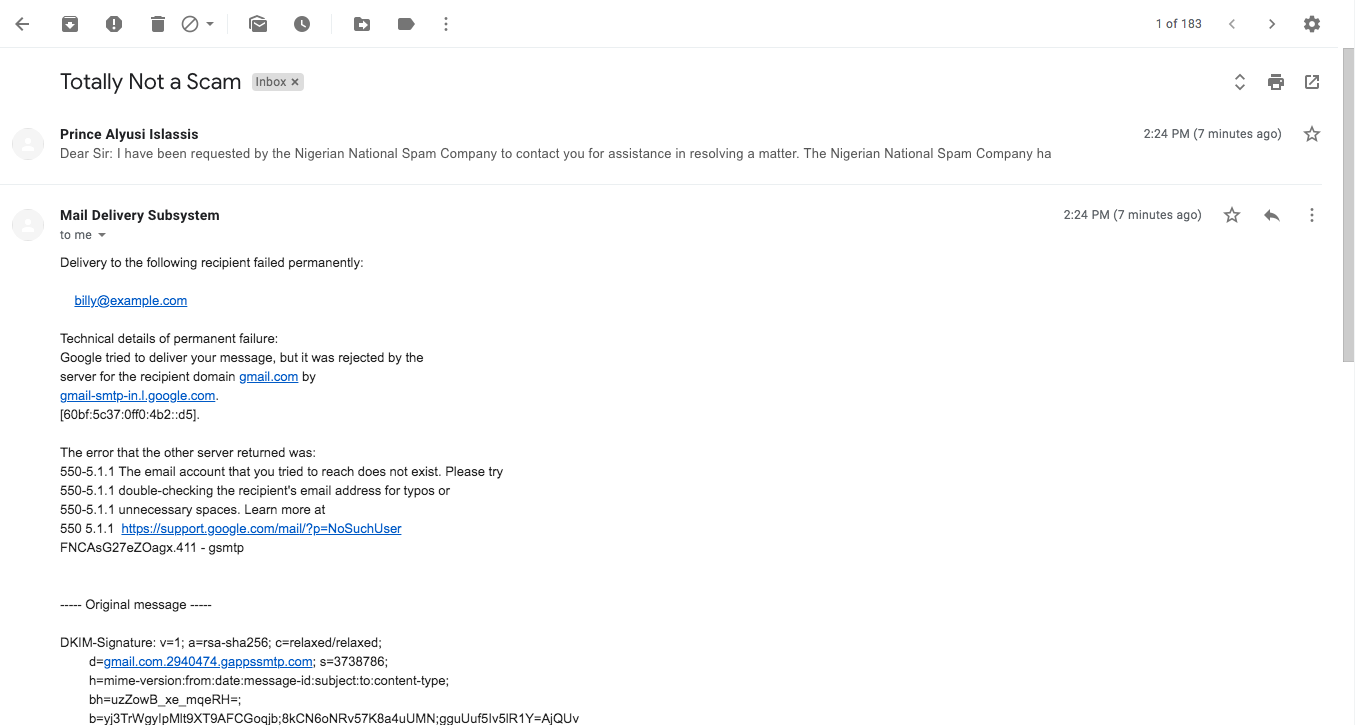 The bounce-back email from the blocked sender's point of view.
With a Plus or Pro account you can bounce back emails to hundreds of senders, and it's simple to toggle on and off with the browser extension.
Aside from the bounce message feature, the app offers a lot of other ways to help clean up your inbox, like domain blocking, word or phrase blocking, IP address blocking, etc.
Are Bounce-Back Emails Actually Effective?
Block Sender's bounce back email looks almost identical to a genuine Gmail delivery failure. It's hard to tell them apart. Any spammer would easily fall for it. See for yourself:
However, it only works against manual, one-to-one emails, not marketing emails, newsletters or spam lists. In some cases, using bounce-back messages on mailing lists can result in more unwanted emails.
For this reason, we recommend using the Fake Bounce Back auto-response only for personal, one-to-one emails - not for promotional messages or newsletters.
Conclusion
Gmail doesn't offer a built-in way to send fake bounce-back emails to specific senders, which is why tools like Block Sender exist. Using Block Sender, you can send bounce-back messages that make it appear as though emails aren’t reaching your inbox.
If you’re dealing with persistent emails and standard blocking isn’t enough, bounce back emails can be a useful option to consider.
